Atomic Highlights
Why Wealth Management Needs Verification at the Point of Payment

August 13, 2026


Two-factor authentication can confirm who entered a platform. It cannot confirm that the payment they are approving is correct.
Security in wealth management has traditionally focused on access: passwords, permissions and multi-factor authentication. These controls remain essential. But they protect only the entrance to the workflow.
The greater operational question comes later: what happens when money is about to move?
Was the request legitimate? Is the amount correct? Is it being paid from the right entity? Have the beneficiary details changed? Does the client understand exactly what they are approving?
Currently this type of authentication is being managed manually by the teams responsible for money movement, and this responsibility leads to human error.

Deloitte found that 85% of family offices use strong passwords or multi-factor authentication. Yet 43% had experienced a cyberattack in the previous 12–24 months, including 25% that had experienced three or more. Among family offices that were attacked, one-third suffered some form of loss or damage.
The problem is not that MFA is ineffective. It is that we occasionally ask it to perform miracles outside its job description.
MFA can help establish that the person accessing an account possesses the required credentials. It cannot determine whether:
Security must therefore extend from identity verification to transaction verification.
The most dangerous payment instructions do not necessarily arrive wearing a balaclava.
They can appear as a routine email from an executive, a familiar capital-call notice or an urgent request to update beneficiary information. Business email compromise reported to the FBI generated more than US$3 billion in losses during 2025.
The Association for Financial Professionals also found that 79% of surveyed organisations experienced attempted or actual payment fraud in 2024. Wire transfers were the payment method most frequently targeted through business email compromise, reported by 63% of respondents. These figures are cross-industry rather than wealth-management-specific, but the mechanism is directly relevant wherever teams regularly process high-value instructions.
FINRA now specifically recommends monitoring wire requests involving new or previously unused third-party accounts, alongside suspicious logins from unidentified browsers or locations.
In other words, the industry does not merely need stronger doors. It needs controls around what authorised users do after they walk through them.

For Atomic Insights, the principle behind secure client verification is straightforward:
The people responsible for the money should retain control of the decision. Technology should make that control explicit, verified and auditable.
That means introducing several distinct layers:
Identity: Is this the correct person?
Authority: Does this person have the right to approve the request?
Intent: Are they approving this specific payment—not merely logging into the platform?
Context: Can they clearly see the amount, client, entity and payment details before confirming?
Evidence: Is there a reliable record of who confirmed the payment, when and through which channel?
No individual layer is infallible. Combined, they make it considerably harder for fraud, impersonation or human error to pass silently through the workflow.
Adding security should not mean forcing every client through the same process.
Atomic’s Secure Client Verifications product direction includes several confirmation routes: a direct SMS response, a secure web application opened from an SMS link with biometric confirmation, native iOS approval using platform biometrics such as Face ID, and client callbacks initiated from the payment request. Calls can be automatically logged with details including who was contacted, when, the number used and the duration, with the option to retain a transcript.
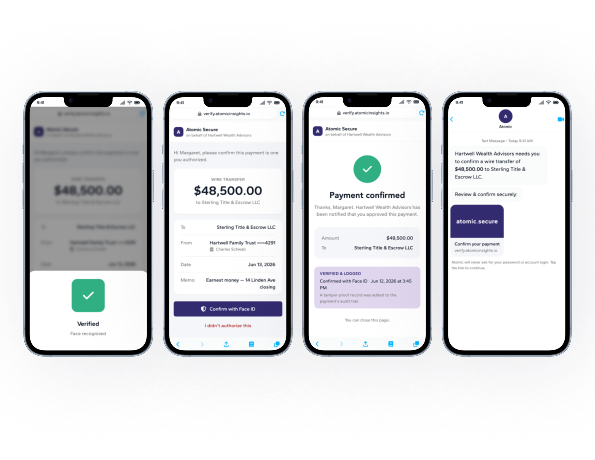
The appropriate layer can depend on the value, risk and circumstances of the payment.
A routine instruction may require a simple confirmation. A high-value payment, changed beneficiary or unusual request may justify biometric approval or a recorded callback. Verification becomes proportionate rather than performative.
Wealth-management firms cannot eliminate every threat or every operational mistake. They can, however, design workflows that make consequential actions harder to fake, overlook or misunderstand.
Passwords protect accounts. Permissions protect roles. MFA protects access.
Verification protects the decision.
For wealth managers, family offices and RIAs handling complex and high-value money movements, that final layer may be the one that matters most.

Atomic Insights © 2026